Non pre-cook lasagne does not necessarily live up to its promise of saving you trouble. Cooked from raw, it can absorb a good deal of sauce, leaving you with a dry wodge in the oven dish; if bits of the pasta are uncovered by sauce, they remain brittle.
You can ensure more even cooking by blanching the sheets for a minute. But you have to do so in small batches, because otherwise the sheets stick together, as if superglued. Pouring boiling water on to a batch of sheets, as Yotam Ottolenghi once advised (see this entry), is asking for trouble.
However, you can soak all the sheets you need in cold water. After 5 to 10 minutes, they should be floppy. If they look as if they’re sticking, they can be peeled apart (because you don’t have to put your hands in scalding water); but I have found that they do not stick hard. You’ve saved yourself the trouble of boiling the pasta and laying out the sheets separately; and you have ensured that it will cook evenly.
Having said this, I should add that this kind of lasagne is not as nice as fresh, or as the dried variety that does require pre-cooking. But in many shops and delis nowadays, it is all that is available.
Showing posts with label Pasta and grains. Show all posts
Showing posts with label Pasta and grains. Show all posts
Sunday, March 30, 2014

Friday, April 19, 2013
Spaghetti carbonara, plus
With pasta sauces, less is more. But sometimes, nutrition is as important a consideration as authenticity. With two daughters to feed, and having in the house the ingredients for a carbonara and only a few vegetables (including the remnants of a packet of frozen petit-pois), I produced this. Our tastes are not particularly refined. Serves 3.
Olive oil
350g spaghetti
Olive oil
150g pancetta, cubed
1/4 clove garlic, finely chopped
2 banana shallots, finely sliced
Bunch of purple sprouting broccoli, sliced from the top, with the toughest parts of the lower stems discarded
70g frozen petit pois
3 eggs, lightly beaten
Scraping of nutmeg
50g parmesan or pecorino, grated
Salt and pepper
Bring a large pan of water to the boil, salt it generously, and immerse the spaghetti, allowing the submerged portions to soften so you can stir in the rest. Cook at a lively boil, stirring regularly.
Meanwhile, gently fry the pancetta in a heavy pan in a splash of oil. Allow it to brown and shed its fat, then throw in the garlic and shallots. Stir regularly. The shallots should soften in four to five minutes.
Keep testing the spaghetti. (The packet instructions will give a rough guide to the cooking time, but cannot be taken as definitive.) When it is nearly ready, throw in the broccoli and peas. After a further minute and a half, tip the contents of the pan into a colander.
Tip the drained spaghetti, broccoli and peas into the pan with the pancetta and shallots. Toss everything. Turn off the heat, and pour in the eggs (to which you have added the nutmeg, and possibly salt and pepper – but go easy with the salt). Toss again, until the spaghetti mixture is coated with lightly curdled egg. Tip in the cheese, and toss again.
Olive oil
350g spaghetti
Olive oil
150g pancetta, cubed
1/4 clove garlic, finely chopped
2 banana shallots, finely sliced
Bunch of purple sprouting broccoli, sliced from the top, with the toughest parts of the lower stems discarded
70g frozen petit pois
3 eggs, lightly beaten
Scraping of nutmeg
50g parmesan or pecorino, grated
Salt and pepper
Bring a large pan of water to the boil, salt it generously, and immerse the spaghetti, allowing the submerged portions to soften so you can stir in the rest. Cook at a lively boil, stirring regularly.
Meanwhile, gently fry the pancetta in a heavy pan in a splash of oil. Allow it to brown and shed its fat, then throw in the garlic and shallots. Stir regularly. The shallots should soften in four to five minutes.
Keep testing the spaghetti. (The packet instructions will give a rough guide to the cooking time, but cannot be taken as definitive.) When it is nearly ready, throw in the broccoli and peas. After a further minute and a half, tip the contents of the pan into a colander.
Tip the drained spaghetti, broccoli and peas into the pan with the pancetta and shallots. Toss everything. Turn off the heat, and pour in the eggs (to which you have added the nutmeg, and possibly salt and pepper – but go easy with the salt). Toss again, until the spaghetti mixture is coated with lightly curdled egg. Tip in the cheese, and toss again.
Saturday, February 02, 2013
Spiced cauliflower, for pasta or couscous
You can perform many variations on this theme of spiced cauliflower with raisins, a Sicilian dressing for pasta. The first version I came across was by Valentina Harris (her Italian Regional Cookery, an out-of-print BBC book), and included tinned sardines, tomato puree, and saffron.
I like the paprika in the version below, in part because I think that a dish of pasta and cauliflower, or even couscous and cauliflower, can appear too pale.
150ml chicken stock
1 cauliflower, broken into florets – I divide the larger ones
2tbsp olive oil
1 clove garlic, chopped
1 red onion, chopped
1tbsp paprika
1tsp turmeric
Cayenne pepper to taste, or whizzed dried chillis to taste
Salt
Handful of raisins, soaked for 10 minutes in boiling water, sieved and gently squeezed
Handful of pine nuts, toasted in a small pan over a gentle heat – careful: they burn easily
Bring the stock to a simmer in a large pan, throw in the cauliflower, and cover. Steam for about four to five minute, or until the florets are just starting to soften. Remove the florets to a plate with a slotted spoon.
In another pan, warm the olive oil over a low to medium heat, throw in the garlic and onion, and soften for five to 10 minutes. Turn down the heat and/or add more oil if the vegetables threaten to catch.
Add the paprika, turmeric, and cayenne or chillis, with salt to taste. Stir around for a few seconds, and pour in the reserved stock. Bring to a simmer. Tip in the cauliflower, put on the lid, and leave to warm through for a few minutes. Stir in the raisins and pine nuts, and leave for a further minute.
I like the paprika in the version below, in part because I think that a dish of pasta and cauliflower, or even couscous and cauliflower, can appear too pale.
150ml chicken stock
1 cauliflower, broken into florets – I divide the larger ones
2tbsp olive oil
1 clove garlic, chopped
1 red onion, chopped
1tbsp paprika
1tsp turmeric
Cayenne pepper to taste, or whizzed dried chillis to taste
Salt
Handful of raisins, soaked for 10 minutes in boiling water, sieved and gently squeezed
Handful of pine nuts, toasted in a small pan over a gentle heat – careful: they burn easily
Bring the stock to a simmer in a large pan, throw in the cauliflower, and cover. Steam for about four to five minute, or until the florets are just starting to soften. Remove the florets to a plate with a slotted spoon.
In another pan, warm the olive oil over a low to medium heat, throw in the garlic and onion, and soften for five to 10 minutes. Turn down the heat and/or add more oil if the vegetables threaten to catch.
Add the paprika, turmeric, and cayenne or chillis, with salt to taste. Stir around for a few seconds, and pour in the reserved stock. Bring to a simmer. Tip in the cauliflower, put on the lid, and leave to warm through for a few minutes. Stir in the raisins and pine nuts, and leave for a further minute.
Sunday, October 21, 2012
Chorizo sauce for pasta
For 2
4 chorizos (the uncooked kind)
Olive oil
1 clove garlic, chopped
1 large red onion, sliced
1 large red pepper, deseeded, cut into fork-size pieces
Salt
Chorizos, unlike ordinary sausages when cut up, do not have a tendency to stick to the pan. You may not get a sauce flavoured with crusty bits, but you do get the paprika-spiked oil that the sausages release.
How you cut them up is a matter of taste. You may like discs; I prefer to skin them, and chop them into small pieces.
Put a splash of oil into a heavy pan over a gentle heat. Throw in the chopped chorizos, and fry them gently until they lose their raw colour and throw off their oil. You may find that you now have plenty of oil with which to cook the garlic, onion, and pepper, which you add to the pan now, with a little salt. Stir everything, and cover the pan, cooking the contents gently until the onions and peppers are soft. If they exude a lot of liquid, evaporate it by uncovering the pan while you cook the pasta.
I like conchiglie (shells), or tortiglioni (big tubes, larger than penne), with this.
Of course, numerous variations are possible. You might, for example, add cumin (1tsp), throwing it into the pan and frying it for a minute before adding the vegetables. You might heat up the sauce with dried chillis, or with a tsp of harissa, stirred in once the onions and peppers have started to collapse.
4 chorizos (the uncooked kind)
Olive oil
1 clove garlic, chopped
1 large red onion, sliced
1 large red pepper, deseeded, cut into fork-size pieces
Salt
Chorizos, unlike ordinary sausages when cut up, do not have a tendency to stick to the pan. You may not get a sauce flavoured with crusty bits, but you do get the paprika-spiked oil that the sausages release.
How you cut them up is a matter of taste. You may like discs; I prefer to skin them, and chop them into small pieces.
Put a splash of oil into a heavy pan over a gentle heat. Throw in the chopped chorizos, and fry them gently until they lose their raw colour and throw off their oil. You may find that you now have plenty of oil with which to cook the garlic, onion, and pepper, which you add to the pan now, with a little salt. Stir everything, and cover the pan, cooking the contents gently until the onions and peppers are soft. If they exude a lot of liquid, evaporate it by uncovering the pan while you cook the pasta.
I like conchiglie (shells), or tortiglioni (big tubes, larger than penne), with this.
Of course, numerous variations are possible. You might, for example, add cumin (1tsp), throwing it into the pan and frying it for a minute before adding the vegetables. You might heat up the sauce with dried chillis, or with a tsp of harissa, stirred in once the onions and peppers have started to collapse.
Saturday, September 01, 2012
Skillet lasagne

My recipe is an adaptation, in part because I was cooking for a different number of people.
The only ricotta in my corner shop was Cypriot, and turned out to be quite unlike the real thing: as you can see in the picture above, slices of it remained intact when warmed.
Serves 3 to 4
Olive oil
1 onion, peeled and chopped
3 cloves garlic, peeled and chopped
Dried chillis to taste, finely chopped (in a coffee grinder or small electric mill)
200g minced beef
200g minced pork
Salt
1 bay leaf
300g lasagne sheets (the variety that does not need pre-cooking)
500g carton passata
Water or stock
200g ricotta
4tbsp Parmesan, grated
Warm a tbsp or 2 of olive oil over a low to medium heat in a 28cm frying pan, if you have one with a lid. (I used a shallow casserole dish.) Throw in the onion, garlic, and chillis (if using), and cook, stirring, until softened – about five minutes. Regulate the heat, and/or add more oil, if the onion threatens to catch.
Add the pork and beef mince, along with salt to taste and the bay leaf, and continue to cook until the meat is broken up and is no longer pink. (The book does not suggest that you need to brown the mince, and is in line with other recipes in giving this advice – see previous entries on Bolognese and moussaka.)
Turn the heat to its lowest. Break each lasagne sheet into four or five pieces, and lay the pieces on top of the meat. Pour over the passata, along with enough water or stock to cover the lasagne pieces.
Turn up the flame slightly to bring the contents of the pan to a simmer, then turn it down again, and put on the lid.
Stir the meat and lasagne mixture after five minutes. Try to separate the lasagne pieces, which may stick together. Put the lid back on, but keep stirring the dish regularly.
This kind of lasagne absorbs a good deal of liquid. You may find that you have to add more water or stock, particularly because the thickened mixture may threaten to stick to the pan.
The lasagne should be tender after 20 to 25 minutes. Take it off the heat, and stir in 2tbsp of Parmesan. Dot the surface with dollops of ricotta, cover again, and leave to stand for five minutes.
Sprinkle with the remaining Parmesan, and serve.
I missed the béchamel. But this version was very nice in its own right.
Browning mince
Saturday, May 19, 2012
Spaghetti carbonara
Felicity Cloake's instructions on "How to cook the perfect spaghetti carbonara" look pretty good to me. My version has only slight differences - matters of preference rather than disagreement.
I'd use just two eggs, not bothering with the extra yoke. And I'd probably use a bit more pancetta, because I like it so much.
I'd put just a tiny bit of oil in a pan, and fry the pancetta with the clove of garlic, cut in half; I'd fish out the garlic later. The point is not to have to start with a tbsp of oil, because the pancetta will give off a lot of fat of its own.
If the pancetta is cooked before your pasta is ready, turn off the heat. But turn it back on again as you're about to drain the pasta. Toss the pasta and the pancetta in the hot pan, and turn off the heat again. The contents should be able to curdle the eggs, but not so hot that they stick.
I prefer to keep the eggs and the cheese separate. Tip the eggs over the spaghetti and pancetta, toss until the strands of pasta are coated with curdled egg, and then toss with the cheese.
I like the idea of taking a cup of cooking water from the pasta pan. I've always kept some of the water by draining the pasta over the pan. But it's easier to control the quantity if you pour from a cup - an important advantage when all you need is just enough to loosen the texture.
I'd use just two eggs, not bothering with the extra yoke. And I'd probably use a bit more pancetta, because I like it so much.
I'd put just a tiny bit of oil in a pan, and fry the pancetta with the clove of garlic, cut in half; I'd fish out the garlic later. The point is not to have to start with a tbsp of oil, because the pancetta will give off a lot of fat of its own.
If the pancetta is cooked before your pasta is ready, turn off the heat. But turn it back on again as you're about to drain the pasta. Toss the pasta and the pancetta in the hot pan, and turn off the heat again. The contents should be able to curdle the eggs, but not so hot that they stick.
I prefer to keep the eggs and the cheese separate. Tip the eggs over the spaghetti and pancetta, toss until the strands of pasta are coated with curdled egg, and then toss with the cheese.
I like the idea of taking a cup of cooking water from the pasta pan. I've always kept some of the water by draining the pasta over the pan. But it's easier to control the quantity if you pour from a cup - an important advantage when all you need is just enough to loosen the texture.
Saturday, November 26, 2011
Spaghetti with aubergine and harissa
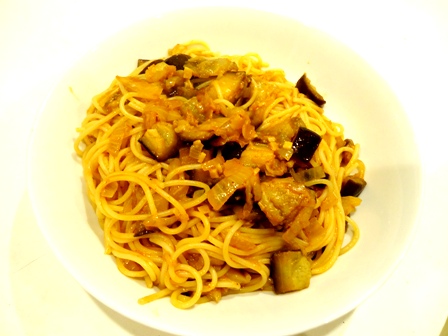
The single portion in the picture contains a whole onion and a whole aubergine (a medium one). As you can see, the quantity is not excessive once the vegetables have cooked down.
I prepared the aubergines according to my newly discovered, saucepan method. The anchovy is there to add some depth of flavour, not to provide fishiness.
2tbsp olive oil
1 clove garlic, chopped
1 medium onion, sliced
1 anchovy, drained
1 medium aubergine
Salt
1tsp harissa
125g spaghetti
Parmesan cheese, grated
Warm the oil in a heavy saucepan over a gentle heat. Throw in the garlic, and let it sizzle gently for 30 seconds or so. Add the onions, and cook for five minutes, or until they start to soften. Stir in the anchovy, and mash it up.
While the onion is cooking, cut the aubergine into small cubes. Tip them into the pan containing the onions, add the salt (to taste) and harissa, give everything a good stir, and put on the lid. Continue to cook, over a gentle heat and with the lid on the pan, stirring regularly. There should be enough liquid and steam from the onions to prevent the vegetables from sticking. The aubergines will be thoroughly soft in 15 to 20 minutes.
Cook the spaghetti according to the packet instructions. Drain, and toss with the vegetables. Serve with the cheese to sprinkle on top.
You could use dried, whizzed chillis instead of the harissa. Or some cayenne pepper. If you don't like hot things, you may need some other ingredient instead - a dstsp of tomato paste, say.
I prepared the aubergines according to my newly discovered, saucepan method. The anchovy is there to add some depth of flavour, not to provide fishiness.
2tbsp olive oil
1 clove garlic, chopped
1 medium onion, sliced
1 anchovy, drained
1 medium aubergine
Salt
1tsp harissa
125g spaghetti
Parmesan cheese, grated
Warm the oil in a heavy saucepan over a gentle heat. Throw in the garlic, and let it sizzle gently for 30 seconds or so. Add the onions, and cook for five minutes, or until they start to soften. Stir in the anchovy, and mash it up.
While the onion is cooking, cut the aubergine into small cubes. Tip them into the pan containing the onions, add the salt (to taste) and harissa, give everything a good stir, and put on the lid. Continue to cook, over a gentle heat and with the lid on the pan, stirring regularly. There should be enough liquid and steam from the onions to prevent the vegetables from sticking. The aubergines will be thoroughly soft in 15 to 20 minutes.
Cook the spaghetti according to the packet instructions. Drain, and toss with the vegetables. Serve with the cheese to sprinkle on top.
You could use dried, whizzed chillis instead of the harissa. Or some cayenne pepper. If you don't like hot things, you may need some other ingredient instead - a dstsp of tomato paste, say.
Saturday, June 11, 2011
Pasta with ricotta and spinach
A sauce made with ricotta left over from the cheesecake recipe. For 2.
250g spinach
1 clove garlic, crushed with a little salt
Small knob of butter
200g ricotta
150g double cream
200-250g pasta (depending on your appetite) - we had spirals
Salt
Wash the spinach, and discard any tough stalks. Lift it from the water, cram it into a saucepan, and cover. Put the saucepan over a high heat for a minute. Lift the lid; if the spinach is starting to wilt, stir it so that the leaves at the top hit the boiling liquid at the bottom of the pan. As soon as all the spinach is wilted, drain it. Either leave the spinach to cool and squeeze it dry with your hands, or do your best to push out the liquid with a wooden spoon. Chop up the leaves.
Bring a large pan of water to the boil, throw in a generous portion of salt, throw in the pasta, stir, and simmer at a generous bubble until al dente - just on the firm side of tenderness.
While the pasta is cooking, melt the butter in a saucepan over a low heat, add the garlic, and allow it to cook gently for a minute. Throw in the spinach, ricotta, and cream, stirring and mashing to blend the ingredients. Add salt to taste. Keep stirring over a low heat until warmed through.
Drain the pasta, and toss with the spinach and ricotta. The sauce is quite bland, even with the garlic: you may like to add a little cayenne, or quite a lot of black pepper. It occurs to me now that the sauce would have been enhanced by the grated rind of half a lemon.
250g spinach
1 clove garlic, crushed with a little salt
Small knob of butter
200g ricotta
150g double cream
200-250g pasta (depending on your appetite) - we had spirals
Salt
Wash the spinach, and discard any tough stalks. Lift it from the water, cram it into a saucepan, and cover. Put the saucepan over a high heat for a minute. Lift the lid; if the spinach is starting to wilt, stir it so that the leaves at the top hit the boiling liquid at the bottom of the pan. As soon as all the spinach is wilted, drain it. Either leave the spinach to cool and squeeze it dry with your hands, or do your best to push out the liquid with a wooden spoon. Chop up the leaves.
Bring a large pan of water to the boil, throw in a generous portion of salt, throw in the pasta, stir, and simmer at a generous bubble until al dente - just on the firm side of tenderness.
While the pasta is cooking, melt the butter in a saucepan over a low heat, add the garlic, and allow it to cook gently for a minute. Throw in the spinach, ricotta, and cream, stirring and mashing to blend the ingredients. Add salt to taste. Keep stirring over a low heat until warmed through.
Drain the pasta, and toss with the spinach and ricotta. The sauce is quite bland, even with the garlic: you may like to add a little cayenne, or quite a lot of black pepper. It occurs to me now that the sauce would have been enhanced by the grated rind of half a lemon.
Tuesday, October 06, 2009
Chicken, couscous and lentils
6 chicken thighs
3 garlic cloves - 2 whole, 1 chopped
Chicken stock
150g green lentils
150g couscous
Handful of pine kernels, toasted in a small saucepan
6 spring onions, sliced (cover them in boiling water and soak them for 30 minutes if you think they may be too assertive)
1 aubergine, cubed, tossed in olive oil, seasoned, baked for 30 minutes until tender
Handful parsley, chopped
1 lime, juiced
Olive oil
Tin of tomatoes
1tsp harissa
Put the thighs in a pan large enough to hold them in a single layer. Pour in stock (or water) to come up to a level with the tops of them. Throw in the whole garlic cloves, with a bay leaf and a few peppercorns. Bring to a simmer and cook on a low heat, covered, until very tender - about 60 to 90 minutes. Remove the thighs to a bowl, and shred.
Use the liquid in which you've cooked the chicken to boil the lentils. Wash the lentils, drain them, and cover with stock with about 2cms to spare. Bring to a simmer, cover, and cook until tender - about 30 minutes. Top up the liquid if and when necessary. When the lentils are nearly tender, uncover the pan and allow the liquid to evaporate.
Put the couscous into a measuring jug, check the level, then return it to the bowl in which you weighed it. Pour stock (you should have some left) or water into the jug to come to the same level. Bring it to a boil in a saucepan, tip in the couscous, make sure it is all soaked, and cover for five minutes.
Warm the chopped garlic in a tbsp olive oil in a saucepan. Tip in the tomatoes, with a little salt and the harissa. Add any stock you have left. (You can break up the tomatoes with a potato masher.) Simmer, uncovered, for 20 minutes.
In a large bowl mix the chicken, lentils, pine kernels, spring onions, aubergines, parsley, lime, and a tbsp or two of olive oil. Serve the tomato sauce on the side.
Monday, June 08, 2009
Spaghetti and tuna
I noticed a recipe for linguine and crab in the Guardian a few weeks ago. Fancying something similar, but having neither crab nor lemon in the house, I tried the following instead. Tinned tuna does not respond well to heating: allow it simply to warm through with the hot spring onions and garlic in a covered pan. Serves 2.
250g spaghetti, spaghettini, or linguine
2tbsp olive oil
4 spring onions, sliced
1 clove garlic, chopped
1 or more dried red chilli (to taste), whizzed
1 tin tuna flakes (in spring water, preferably)
A few splashes of soy sauce
Grated zest of 1 orange
Handful parsley, chopped
Put a large pot of water on to boil. Salt it, and add the spaghetti, allowing it to fold in to the water as it softens. Keep it cooking at a lively simmer.
In a heavy pan and over a gentle flame, soften the spring onions, garlic, and chilli in the oil, for about three minutes. Turn off the heat, and stir in the tuna, soy, orange zest, and parsley. Cover the pan until the pasta is ready.
When the pasta is al dente, drain it, and tip it into the tuna mixture. Stir it through.
250g spaghetti, spaghettini, or linguine
2tbsp olive oil
4 spring onions, sliced
1 clove garlic, chopped
1 or more dried red chilli (to taste), whizzed
1 tin tuna flakes (in spring water, preferably)
A few splashes of soy sauce
Grated zest of 1 orange
Handful parsley, chopped
Put a large pot of water on to boil. Salt it, and add the spaghetti, allowing it to fold in to the water as it softens. Keep it cooking at a lively simmer.
In a heavy pan and over a gentle flame, soften the spring onions, garlic, and chilli in the oil, for about three minutes. Turn off the heat, and stir in the tuna, soy, orange zest, and parsley. Cover the pan until the pasta is ready.
When the pasta is al dente, drain it, and tip it into the tuna mixture. Stir it through.
Monday, February 02, 2009
Don't blanch the lasagne
From a recipe by Yotam Ottolenghi, I found a way to ensure that non pre-cook lasagne was properly cooked (as I wrote here). Before that, I had always blanched the pasta sheets before assembling the pasta.
However, last Saturday in the Guardian Ottolenghi gave a recipe for mushroom lasagne, and told us to pour boiling water on to the sheets, leave them for two minutes, and dry them on a tea towel.
This is a very bad idea. The sheets will stick together, and you will have trouble prising them apart.
Use the dry sheets, breaking them up as necessary to fit them in the dish. As I wrote in the earlier entry: cover the dish, after you have assembled the lasagne, with foil, and cook for 30 minutes at gas mark 4/180C, and then for another 30 minutes at gas mark 2/150C. Test the lasagne with a knife. If the pasta is soft, you could scatter parmesan on top and brown the dish under a grill.
However, last Saturday in the Guardian Ottolenghi gave a recipe for mushroom lasagne, and told us to pour boiling water on to the sheets, leave them for two minutes, and dry them on a tea towel.
This is a very bad idea. The sheets will stick together, and you will have trouble prising them apart.
Use the dry sheets, breaking them up as necessary to fit them in the dish. As I wrote in the earlier entry: cover the dish, after you have assembled the lasagne, with foil, and cook for 30 minutes at gas mark 4/180C, and then for another 30 minutes at gas mark 2/150C. Test the lasagne with a knife. If the pasta is soft, you could scatter parmesan on top and brown the dish under a grill.
Monday, December 01, 2008
Schama's Bolognese
Here is Simon Schama's article from the Guardian about the perfect Bolognese sauce. There are two questionable details: Schama tells you to add the wine after the stock, a procedure that might result in too winey a sauce; and he does not tell you whether to leave the pan covered or not. The Elizabeth David version, at the foot of the piece, tells you to cover the pan: I think that her sauce will be too runny. I like Marcella Hazan's, immediately below the Schama piece: you add milk, and let it evaporate; then wine, and let that evaporate; and then tomatoes, and let the sauce reduce again (with the pan uncovered all the while).
On Saturday, Hugh Feanley-Whittingstall's sauce, to be included in a lasagne, was similar to the Hazan version.
On Saturday, Hugh Feanley-Whittingstall's sauce, to be included in a lasagne, was similar to the Hazan version.
Thursday, November 06, 2008
Squash and couscous
A good many squashes will arrive in the vegetable box over the next few months. Although some recipes specify boiling, I almost always bake them - either in halves, and then scooping out the flesh for a soup; or peeled and cubed.
Peeling them is a pain. The skin is tough, and hard to peel away neatly. I cut the squash into quarters first. The flesh is quite tough too: it can take cubed, fork-sized pieces of squash 45 minutes to soften in a gas mark 5/180C oven.
I toss squash for stirring into couscous in oil - olive or sunflower - and a generous portion (about 2tsps) of cumin seeds. I like toasted pine kernels in there. The dish needs colour to relieve the beige: the other night, I added sun-dried tomatoes and raisins (which I had softened for 20 minutes in hot water), along with garlic fried in olive oil for a minute, and harissa.
Peeling them is a pain. The skin is tough, and hard to peel away neatly. I cut the squash into quarters first. The flesh is quite tough too: it can take cubed, fork-sized pieces of squash 45 minutes to soften in a gas mark 5/180C oven.
I toss squash for stirring into couscous in oil - olive or sunflower - and a generous portion (about 2tsps) of cumin seeds. I like toasted pine kernels in there. The dish needs colour to relieve the beige: the other night, I added sun-dried tomatoes and raisins (which I had softened for 20 minutes in hot water), along with garlic fried in olive oil for a minute, and harissa.
Monday, July 07, 2008
La graine and le mulet
My latest New Statesman column was prompted by the film Couscous (La graine and le mulet), a vivid and affecting study of an Algerian family living in the French port of Sete. The point I try to make is that couscous, meaning both the grains and the feast, resonates as a film title in a way that few other food names would.
Most of the couscous we buy is, unlike the grains Souad prepares in the film, pre-cooked. We do not have to steam it for an hour or so, but simply to soak it. What I used to do was put it into an oven dish, pour over boiling water to moisten but not to drown the grains, cover the dish, and transfer it to the oven for five minutes (at any temperature). A few weeks ago, I checked the instructions on a Ferrero packet, and discovered a method I now prefer.
You put your couscous (about 75g for each person is a decent amount) into a measuring jug. Check the level. Tip the couscous back into a bowl. Pour water into the jug to the same level; transfer the water to a saucepan with a little salt and about a tbsp of olive oil for each 150g of grains; bring the contents of the pan to the boil; tip in the couscous and make sure all the grains are soaked; cover and leave for five minutes. Stir through the couscous with a fork.
Most of the couscous we buy is, unlike the grains Souad prepares in the film, pre-cooked. We do not have to steam it for an hour or so, but simply to soak it. What I used to do was put it into an oven dish, pour over boiling water to moisten but not to drown the grains, cover the dish, and transfer it to the oven for five minutes (at any temperature). A few weeks ago, I checked the instructions on a Ferrero packet, and discovered a method I now prefer.
You put your couscous (about 75g for each person is a decent amount) into a measuring jug. Check the level. Tip the couscous back into a bowl. Pour water into the jug to the same level; transfer the water to a saucepan with a little salt and about a tbsp of olive oil for each 150g of grains; bring the contents of the pan to the boil; tip in the couscous and make sure all the grains are soaked; cover and leave for five minutes. Stir through the couscous with a fork.
Thursday, April 17, 2008
Penne with mushrooms and purple sprouting broccoli
Some vegetables do not go very far. Mushrooms, once they have given off their water, shrink dramatically; you need a substantial bunch of purple sprouting broccoli, even if you keep as much of the stalks as possible, to feed several people. Last night, I used the entire bag of mushrooms and the entire bag of broccoli from the vegetable box in a pasta sauce for three -- and the portions of vegetables were not generous. But there was plenty of cream. More than was healthy, no doubt.
I brought my pasta water to the boil, and dropped in my broccoli for just a couple of minutes. Some people insist that you cook green vegetables this way, rather than steaming them: it retains the colour, they claim. I am not sure about that, but I have never given the argument a proper test. In this recipe, though, it is economical to use the water twice. I fished out the broccoli (with a slotted spoon), and transferred it to a colander. I salted the water, and tipped in 375g of penne.
Meanwhile, I had been cooking my sliced chestnut mushrooms with a chopped clove of garlic, a little salt, and a splash or two of olive oil. My normal practice is to wait for the disgorged water to cook off; but that was not necessary here. The mushrooms were not likely to be undercooked. I poured in an entire 284ml pot of Rachel's Organic double cream, and bubbled it for about five minutes, until it had thickened and reduced. With about a minute to go before the pasta was ready, I added the broccoli to the mushroom sauce to warm through.
I drained the pasta, and tossed it with a large knob of butter (our hearts will need a couple of days to recover); I plated it, and served it with the sauce on top.
I brought my pasta water to the boil, and dropped in my broccoli for just a couple of minutes. Some people insist that you cook green vegetables this way, rather than steaming them: it retains the colour, they claim. I am not sure about that, but I have never given the argument a proper test. In this recipe, though, it is economical to use the water twice. I fished out the broccoli (with a slotted spoon), and transferred it to a colander. I salted the water, and tipped in 375g of penne.
Meanwhile, I had been cooking my sliced chestnut mushrooms with a chopped clove of garlic, a little salt, and a splash or two of olive oil. My normal practice is to wait for the disgorged water to cook off; but that was not necessary here. The mushrooms were not likely to be undercooked. I poured in an entire 284ml pot of Rachel's Organic double cream, and bubbled it for about five minutes, until it had thickened and reduced. With about a minute to go before the pasta was ready, I added the broccoli to the mushroom sauce to warm through.
I drained the pasta, and tossed it with a large knob of butter (our hearts will need a couple of days to recover); I plated it, and served it with the sauce on top.
Monday, February 18, 2008
Lasagne that does what it says on the packet
My latest New Statesman column concerns my liberating discovery that it is possible to cook non-pre-cook lasagne without pre-cooking it. As I say in the column, and as I wrote here, I used to find that the only way to get this product to soften consistently, and to prevent it from absorbing most of the liquid in the sauces, was to give it an initial blanching. Yotam Ottolenghi's potato lasagne, described in this entry, taught me another way.
Here is a recipe for a more conventional lasagne. Once you have assembled the ingredients, cover the dish with foil and put it into the oven at gas mark 4/180C; after 30 minutes, turn down the dial to 2/150C. After another 30 minutes, remove the foil, scatter parmesan on top, and cook at gas mark 6/200C for 15 to 20 minutes, or until the top is browned.
No more entries this week. Back next Monday.
Here is a recipe for a more conventional lasagne. Once you have assembled the ingredients, cover the dish with foil and put it into the oven at gas mark 4/180C; after 30 minutes, turn down the dial to 2/150C. After another 30 minutes, remove the foil, scatter parmesan on top, and cook at gas mark 6/200C for 15 to 20 minutes, or until the top is browned.
No more entries this week. Back next Monday.
Monday, December 17, 2007
Potato lasagne
Here is an unusual recipe, from Yotam Ottolenghi's "New Vegetarian" column in the Saturday Guardian.
Tackling it, I was less worried about the combination of potatoes and lasagne than about whether the ingredients would cook properly. Non pre-cook lasagne is tricky stuff to get right, in my experience. It needs to soak in the other ingredients in order to soften, and it absorbs a lot of liquid; but make your sauces too runny, and you end up with a soggy mass. Too dry, and the lasagne stays crunchy. The owner of a local deli gave me the answer; parboil the sheets for a minute. It makes them far less absorbent, and allows you to cook the dish in the normal way, with ragu and bechamel at the consistency you like. But the sheets sometimes curl up after their parboiling; and what is the point of this type of lasagne if you have to pre-cook it anyway? So I decided to try Ottolenghi's method. He includes plenty of liquid.
To fit the lasagne into my dish, I had to break up the sheets. Little shards split off; but that did not seem to matter.
I was not sure about mixing cheese and garlic with the water, milk and cream before pouring the mixture over the layered lasagne. The solids would sink; they would emerge in a clump when you poured, and sit in a mass on the top of the dish. So I layered the cheese with the lasagne sheets, potatoes and onions. The best way to incorporate the garlic, I realise with hindsight, would have been to blitz it with the olives. I also realise with hindsight that heating the liquid first would have helped along the cooking.
I used new potatoes, peeled and sliced very thin. After an hour in the oven (half the time at gas mark 4/180C, and half at gas mark 2/150C), the dish was not very well cooked. I removed the foil, and pressed down on the top of the lasagne: the liquid rose above the surface. I scattered cheese on top, and put the dish back in the oven at gas mark 5/190C for a further 30 minutes. It emerged well-browned, with the liquid absorbed; but the potatoes were not entirely soft. Heating the liquid first, and pressing down on the ingredients after the first 30 minutes to ensure that everything was soaked, would probably have sorted them out.
My dish included 200 g of lasagne, and eight small new potatoes. I cut down the liquid, using 100 ml of water, 200 ml of double cream, and 150 ml of milk. I did not use herbs, and I reduced the garlic from four cloves to three. The quantities of the other ingredients were the same.
Two of us ate it all, including the slightly crisp potatoes. With just a green salad on the side.
Tackling it, I was less worried about the combination of potatoes and lasagne than about whether the ingredients would cook properly. Non pre-cook lasagne is tricky stuff to get right, in my experience. It needs to soak in the other ingredients in order to soften, and it absorbs a lot of liquid; but make your sauces too runny, and you end up with a soggy mass. Too dry, and the lasagne stays crunchy. The owner of a local deli gave me the answer; parboil the sheets for a minute. It makes them far less absorbent, and allows you to cook the dish in the normal way, with ragu and bechamel at the consistency you like. But the sheets sometimes curl up after their parboiling; and what is the point of this type of lasagne if you have to pre-cook it anyway? So I decided to try Ottolenghi's method. He includes plenty of liquid.
To fit the lasagne into my dish, I had to break up the sheets. Little shards split off; but that did not seem to matter.
I was not sure about mixing cheese and garlic with the water, milk and cream before pouring the mixture over the layered lasagne. The solids would sink; they would emerge in a clump when you poured, and sit in a mass on the top of the dish. So I layered the cheese with the lasagne sheets, potatoes and onions. The best way to incorporate the garlic, I realise with hindsight, would have been to blitz it with the olives. I also realise with hindsight that heating the liquid first would have helped along the cooking.
I used new potatoes, peeled and sliced very thin. After an hour in the oven (half the time at gas mark 4/180C, and half at gas mark 2/150C), the dish was not very well cooked. I removed the foil, and pressed down on the top of the lasagne: the liquid rose above the surface. I scattered cheese on top, and put the dish back in the oven at gas mark 5/190C for a further 30 minutes. It emerged well-browned, with the liquid absorbed; but the potatoes were not entirely soft. Heating the liquid first, and pressing down on the ingredients after the first 30 minutes to ensure that everything was soaked, would probably have sorted them out.
My dish included 200 g of lasagne, and eight small new potatoes. I cut down the liquid, using 100 ml of water, 200 ml of double cream, and 150 ml of milk. I did not use herbs, and I reduced the garlic from four cloves to three. The quantities of the other ingredients were the same.
Two of us ate it all, including the slightly crisp potatoes. With just a green salad on the side.
Monday, November 12, 2007
Good noodles

I have written here before about trying to keep Chinese noodles from clumping together. You simmer them, drain them, and keep them soaking in cold water -- but not for too long -- until you need them. But a better option would be to find a brand of noodles that are not sticky; and at last I have. They are Blue Dragon egg noodles. You simmer them for about three minutes. When drained, the linguine-like strands remain slippery and separate.
The vegetables were a less satisfactory aspect of our most recent stir-fry. I do not own a wok, and rarely feel that I need one. But the ingredients the other night included pak choi, which exudes quite a bit of liquid; my frying pan did not reach as high a temperature as a wok would have done, so the liquid took too long too evaporate, and the vegetables stewed rather than fried. Still, with some soy, fish and chilli sauces, along with a little sesame oil, they tasted fine.
Wednesday, October 03, 2007
Pasta with anchovies and roasted peppers
Anchovies go well with green vegetables (here, for example). But they also go with mushrooms (here), and with peppers. I put together this dish last night: it does not need the spring onions, which I used because I had them in the house; I included chillis because I always do. The spaghetti worked well, despite the usual advice that cream sauces suit shapes such as penne better. For two.
2 red peppers
I tbsp olive oil
4 spring onions, sliced (optional)
I clove garlic, chopped
200 ml double cream
I tin anchovies, drained
1 or more dried chillis according to taste, whizzed (optional)
Pepper
250 g spaghetti
Roast the peppers in a gas mark 6/200 C oven for 20 to 30 minutes until the skin blackens. Allow them to cool. Peel, deseed and slice them, retaining the juice. (I break the peppers apart with my hands above a bowl, discarding into it skin, seeds and juice.)
Soften the spring onions (if using) and the garlic in the olive oil. Pour in the juice from the peppers through a sieve, allowing it to bubble and thicken for a minute or two; pour in the cream, the anchovies, and the chillis if using. Grind over the pepper. Allow this sauce to bubble and thicken. (The anchovies should melt.) Tip in the strips of pepper, and give them time to warm.
Meanwhile, cook the spaghetti. Drain it, and toss it through the sauce.
2 red peppers
I tbsp olive oil
4 spring onions, sliced (optional)
I clove garlic, chopped
200 ml double cream
I tin anchovies, drained
1 or more dried chillis according to taste, whizzed (optional)
Pepper
250 g spaghetti
Roast the peppers in a gas mark 6/200 C oven for 20 to 30 minutes until the skin blackens. Allow them to cool. Peel, deseed and slice them, retaining the juice. (I break the peppers apart with my hands above a bowl, discarding into it skin, seeds and juice.)
Soften the spring onions (if using) and the garlic in the olive oil. Pour in the juice from the peppers through a sieve, allowing it to bubble and thicken for a minute or two; pour in the cream, the anchovies, and the chillis if using. Grind over the pepper. Allow this sauce to bubble and thicken. (The anchovies should melt.) Tip in the strips of pepper, and give them time to warm.
Meanwhile, cook the spaghetti. Drain it, and toss it through the sauce.
Wednesday, September 19, 2007
Macaroni cheese
Smothering pasta in a flour-based sauce is not the kind of thing that Italians would do. But macaroni cheese is one of those dishes -- curry is another -- for which I get cravings.
Sometimes, I bake it. Baking dries up the sauce a little, and makes the pasta rather sticky -- but that can be what you want. Simply finishing the dish under the grill retains all the sauce and ensures that the pasta remains separate.
Heat up the water for the pasta.
Gruyere, Comte and Cantal are all good cheeses to use. I like a strong Cheddar best -- about 3 heaped tbsps for each person. After grating it, grate a little nutmeg on top. Grate also about 2 tbsps of Parmesan.
Warm a gratin dish. When the pasta goes in, it should not cool down.
You can make the sauce in the eight to 10 minutes it takes the pasta to cook. I use penne; conchiglie also work well, as do most shapes other than spaghetti or other ribbon types. About 100 g for each person, thrown into the boiling water with plenty of salt (about a tsp for each litre of water), is enough in this rich dish.
I like a generous quantity of cheesy bechamel: about as much as will be thickened by a generous dstsp of flour for each person. (You will need about 300 to 350 ml of milk for each serving, in other words.) Stir the flour into enough melted butter (about 20 g for each dstsp) to make a roux that is the texture of damp sand, and cook it over a gentle heat for about a minute -- long enough for some of the floury taste to be cooked out, but not long enough for the butter to brown. Turn up the heat to medium, and add the milk a few splashes at a time, incorporating each before pouring in the next. (If you have cream, you might like to use that instead of about a third of the milk.) The sauce should be of a coating consistency, but not stiff. When it is bubbling, stir in the cheese (with the nutmeg) until melted, and turn off the heat. Grind in pepper if you like. You do not need salt.
Drain the pasta. Stir it into the sauce; or, if the sauce is not sitting in a large enough pan, stir the pasta and sauce together in the pasta pan. Tip the mixture into the warmed gratin dish, sprinkle the Parmesan on top, and put the dish under the grill. (I remove the rack from the grill pan and put the dish in it, for easy manoeuvrability.) Watch out: Parmesan burns very easily.
Sometimes, I bake it. Baking dries up the sauce a little, and makes the pasta rather sticky -- but that can be what you want. Simply finishing the dish under the grill retains all the sauce and ensures that the pasta remains separate.
Heat up the water for the pasta.
Gruyere, Comte and Cantal are all good cheeses to use. I like a strong Cheddar best -- about 3 heaped tbsps for each person. After grating it, grate a little nutmeg on top. Grate also about 2 tbsps of Parmesan.
Warm a gratin dish. When the pasta goes in, it should not cool down.
You can make the sauce in the eight to 10 minutes it takes the pasta to cook. I use penne; conchiglie also work well, as do most shapes other than spaghetti or other ribbon types. About 100 g for each person, thrown into the boiling water with plenty of salt (about a tsp for each litre of water), is enough in this rich dish.
I like a generous quantity of cheesy bechamel: about as much as will be thickened by a generous dstsp of flour for each person. (You will need about 300 to 350 ml of milk for each serving, in other words.) Stir the flour into enough melted butter (about 20 g for each dstsp) to make a roux that is the texture of damp sand, and cook it over a gentle heat for about a minute -- long enough for some of the floury taste to be cooked out, but not long enough for the butter to brown. Turn up the heat to medium, and add the milk a few splashes at a time, incorporating each before pouring in the next. (If you have cream, you might like to use that instead of about a third of the milk.) The sauce should be of a coating consistency, but not stiff. When it is bubbling, stir in the cheese (with the nutmeg) until melted, and turn off the heat. Grind in pepper if you like. You do not need salt.
Drain the pasta. Stir it into the sauce; or, if the sauce is not sitting in a large enough pan, stir the pasta and sauce together in the pasta pan. Tip the mixture into the warmed gratin dish, sprinkle the Parmesan on top, and put the dish under the grill. (I remove the rack from the grill pan and put the dish in it, for easy manoeuvrability.) Watch out: Parmesan burns very easily.
Subscribe to:
Posts (Atom)