Saturday, November 26, 2011

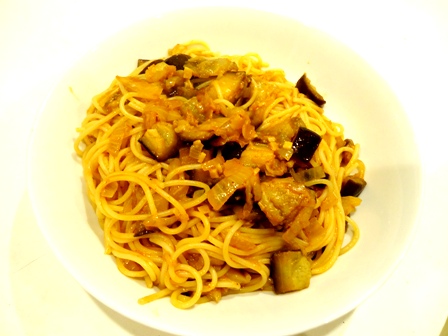
Spaghetti with aubergine and harissa

The single portion in the picture contains a whole onion and a whole aubergine (a medium one). As you can see, the quantity is not excessive once the vegetables have cooked down.

I prepared the aubergines according to my newly discovered, saucepan method. The anchovy is there to add some depth of flavour, not to provide fishiness.

2tbsp olive oil
1 clove garlic, chopped
1 medium onion, sliced
1 anchovy, drained
1 medium aubergine
Salt
1tsp harissa
125g spaghetti
Parmesan cheese, grated


Warm the oil in a heavy saucepan over a gentle heat. Throw in the garlic, and let it sizzle gently for 30 seconds or so. Add the onions, and cook for five minutes, or until they start to soften. Stir in the anchovy, and mash it up.

While the onion is cooking, cut the aubergine into small cubes. Tip them into the pan containing the onions, add the salt (to taste) and harissa, give everything a good stir, and put on the lid. Continue to cook, over a gentle heat and with the lid on the pan, stirring regularly. There should be enough liquid and steam from the onions to prevent the vegetables from sticking. The aubergines will be thoroughly soft in 15 to 20 minutes.

Cook the spaghetti according to the packet instructions. Drain, and toss with the vegetables. Serve with the cheese to sprinkle on top.

You could use dried, whizzed chillis instead of the harissa. Or some cayenne pepper. If you don't like hot things, you may need some other ingredient instead - a dstsp of tomato paste, say.

Saturday, November 19, 2011

Chocolate cake, refined

I have learned a little bit more about how cakes work from revising and expanding my cookbook, Don't Sweat the Aubergine, for a new edition to be published by Black Swan in the spring. It made me think again about Elizabeth David's simple and delicious chocolate cake, which is often somewhat compacted after a day or so. If the egg foam cannot sustain an airy texture for very long, would the cake not benefit if one creamed the butter and sugar as well? Indeed it would. I have added a note to the original recipe.

Sunday, November 13, 2011

Faster beetroot

The other day, I cooked a very large beetroot. I gave it a quick wash, put it in a pan half filled with boiling, salted water, and part-boiled, part-steamed it with the lid on. It took the best part of two hours.

On Thursday, I read this recipe by Angela Hartnett in the Guardian. You wash the beetroot, cut it in quarters, and cook it in olive oil, thyme, vinegar and water. Hartnett suggests that quarters of a medium beetroot will cook in about 15 minutes.

The quicker you cook vegetables, the better, is the usual rule - certainly as far as nutritional value is concerned. My doubt here is the juice that leaks into the water through the cut surface of the beetroot. But perhaps plenty of juice leaks out during the longer cooking period anyway. (Baking beetroot wrapped in foil does not produce a notably juicier result, in my experience.)

I tried the Hartnett method. But my quartered beetroot was nowhere near cooked after 15 minutes; nor after 30 minutes. It occurred to me that the vinegar was the problem: acidity is a highly effective delayer of the softening process.

Eventually, I ran out of patience, and drained the beetroots while they were still quite firm. Angela Hartnett makes no mention of peeling, but I did peel mine, once they were cool.

The result was good. I'll certainly try this quartering method again, leaving out the vinegar, in the hope that the flavour did not depend on it.

Sunday, November 06, 2011

Squash and tahini paste

This is an adaptation of a Yotam Ottolenghi recipe in the Guardian. I spiced it with cumin rather than cinnamon; because we were eating it at lunchtime, I left out the garlic; and I didn't garnish it with sesame seeds, date syrup, and coriander. It was still delicious and, as Ottolenghi says, moreish.

Also, I didn't cut up the squash before baking it, figuring that I would waste less of the flesh if I were able to scoop it, softened, out of the shells. But it took a long time to cook. I gave it half an hour at gas mark 6/200C, with the roasting tin covered in foil; then I uncovered the tin, but turned down the oven to gas mark 3/160, and waited another 30 minutes; discovering that the flesh was still not tender, I covered the tin again, turned up the oven back to 200C, and waited for a further 30 minutes. That did it.

The two halves of squash in the picture are anointed with about a dstsp of olive oil, half a tsp of cumin seeds, and salt and pepper. I scooped the flesh into a small vegetable mill, and whizzed it. I added a tbsp of yoghurt, and whizzed again. I added a tbsp of tahini paste (it is easier to merge this thick paste with a substance that is already blended), and whizzed for a final time.

Saturday, October 29, 2011

Coconut chicken curry

This is a one-pot meal, to be served in bowls and eaten with a spoon. What surprised me was that the potatoes took a while to soften - I had thought that the coconut milk would tenderise them, but perhaps I acidified the liquid with the other ingredients. (If you want crunchy potatoes, try cooking them in tomato sauce.) Nevertheless, I think that new potatoes, which hold their shape, are the kind to go for here.

Serves 2, generously.

Spices

1tsp cumin seeds
1/2tsp mustard seeds
6 cardamom pods
1tsp turmeric
1/6tsp asafoetida
1/4tsp dried ginger, or (better) fresh
Cayenne pepper to taste

Sunflower oil
1 clove garlic, chopped
1 onion, chopped
1 tin coconut milk
150ml chicken stock (I confess I used half a cube and 150ml water)
2 sweet peppers, deseeded and cut into fork-sized pieces
8 new potatoes, cut into fork-sized pieces
1 tin chickpeas, drained
Salt
1 large chicken supreme, cut into fork-sized pieces
3 spring onions, chopped
Chillis, chopped
1tbsp lime juice


Warm the cumin and mustard seeds in a saucepan over a gentle heat, until toasted. Grind them, with the cardamom, in a mortar.

In a large saucepan or casserole, warm about 2 tbsps of sunflower oil over a gentle heat, throw in the garlic, and then the onion. Cook gently, stirring, and adding a bit more oil if it threatens to catch. When the onion is soft, tip in the cumin, mustard seeds and cardamom, and cook gently, again stirring, for about three minutes.

Pour in the coconut milk and stock. Add the peppers, potatoes, and chickpeas, as well as the remaining spices. Bring to a simmer, and add salt cautiously (the chick peas will have been canned in salty water, and the stock cube, if you used one, is salty too). Cover, and simmer gently for 15 minutes. Add the chicken and spring onions, and simmer for a further 15 minutes, or until the potatoes are tender and the chicken is cooked through.

Turn off the heat. Stir through the chillis (as many as you like), and the lime juice. Coriander would be nice, too.

Saturday, October 22, 2011

Aubergines in the pan

I find frying cubes of aubergines unsatisfactory. As everyone who has cooked them knows, aubergines absorb a great deal of oil; then they stick to the pan. It is not an efficient way of softening them. My usual method - in this recipe, for example - is to toss them in oil and to bake them.

However, it occured to me the other day that I could cook them in a pan if the pan offered a moist environment, such as that created by softened onions. The pan in the picture contains two red onions, softened in olive oil with some garlic. I threw in the aubergines, tossed them in the oily onions, and covered the pan, cooking them over a low flame. I stirred them from time to time. In 15 to 20 minutes they were soft, and with a more melting texture than you get when you bake them.

Saturday, October 08, 2011

Lentil stew with morcilla

Morcilla is a Spanish black pudding. The stuff I bought came in balls tied with string.
Puy lentils take longer to cook than is stated on the packets and in most recipes, in my experience. Soaking speeds the process of tenderising them. It also ensures that they absorb less liquid while cooking: you can barely cover them, and be reasonably confident that they will soften. If your water is hard, you may get better results if you use filtered water.

Serves two.

Olive oil
1 clove garlic, chopped
1 medium onion, chopped
150g Puy lentils, soaked for two hours or longer
Chicken stock
150g morcilla
Salt
Pepper
Handful of flat-leaf parsley, chopped


Warm about 2tbsps of olive oil in a heavy pan, throw in the garlic, let it sizzle gently for a minute, and throw in the onion. Cook over a low heat until the onion starts to soften - five to 10 minutes. If the onion threatens to catch, add more oil.

Drain and rinse the lentils. Tip them into the pan, and pour in just enough stock to cover. Bring to a simmer, put a lid on the pan, and simmer gently until the lentils soften. It may take 20 to 30 minutes. Add more stock if the top layer of lentils becomes exposed.

Once the lentils are soft or nearly there, you may want to uncover the pan and turn up the heat slightly, to get a less soupy consistency. You'll need to stir the lentils regularly, because they'll catch as the liquid evaporates and the stew thickens.

Add salt to taste. (But I must admit that I've never properly tested the theory that salt added at an earlier stage compromises the texture of lentils, as it does dried beans.)

Cut the morcilla into fork-sized pieces, submerge them in the lentils, and give them five minutes to warm through. Stir in the chopped parsley. The stew would benefit from plenty of pepper; I stirred harissa into mine.

Saturday, October 01, 2011

Flipping an omelette

My usual method for preparing a slow-cooked omelette such as a frittata is to put it on the lowest flame on the hob until the underside is set, and to finish it under the grill. But recently I was at a party for which someone had prepared the most delicious tortilla; and he told me - as if anyone who performed the task differently was guilty of a bizarre solecism - that he always flipped the tortilla, with the help of a plate. So I tried it with the above frittata, consisting simply of eggs and Gruyere.

You place the plate over the pan, and flip pan and plate rapidly. The omelette is slippery at this stage, and can slide off the plate altogether. It is runny too: runny egg remains on the plate when you return the omelette to the pan, and has to be scraped off, back over the omelette.

Is this omelette more tender than the grilled version? It will be if you tend to grill it too fiercely. Otherwise, I'm not sure.

Saturday, September 24, 2011

Pork and marinade

If you barbecue a thick or tough cut of meat, you may well need to cook it first, before marinating it and subjecting it to the fiercely hot coals. But what if you are cooking it indoors? Do you still need a two-stage process, when you can get decent results by simply putting the marinated meat in a low to medium oven?

I often buy spare rib chops, cut them into pieces, coat them in a marinade, and cook them in a low oven. But this cut gives off quite a bit of liquid, which you have to allow to evaporate before the meat browns and the marinade turns sticky. You don't know how long that will take, and you may have to fiddle with the oven temperature to speed the process. The pork can become tough.

I poached four chops (in a pot with a chicken carcass - they contributed to the resultant stock) for about 50 minutes. Then I cut them up and marinated them. Later I cooked them under the grill until browned and warmed through, first on a high heat, then on a lower one.

It works better than the one-stage method, I think. The meat is more tender, and the marinade penetrates it more efficiently.

Marinade recipes here and here.

Saturday, September 17, 2011

Stuffed courgette

We received this yellow courgette, the size of a small marrow, in our vegetable box. It would be useless for sautéing in the normal way, because it is too watery. But it is fine for stuffing. You can scoop out the flesh much more easily than you would that of, say, an aubergine.

My stuffing consisted of the flesh and ingredients I happened to have in the house: olive oil, 1 red onion, 1 chopped clove of garlic, 75g rice, 60g diced Gruyere, a tbsp of cream cheese (I'm not sure that this was a good idea, but I thought the bit left in the tub needed using), salt, cayenne pepper. Extra or substitutional ingredients might have been pre-soaked raisins, toasted pine nuts, a few anchovies, and herbs such as flat-leaf parsley, tarragon, or thyme.

Cook the rice in the normal way. (There's plenty of advice, only some of it inconsistent, on this blog.) Meanwhile, finely chop the onion, and gently cook it with the garlic in a tbsp or two of olive oil. Chop up the courgette flesh, throw it into the pan, and gradually turn up the heat as it exudes water. Cook it on a high heat until the water evaporates. Stir in the rice, cheese, and seasoning.

Put the courgette halves in a baking dish or roasting tin, and stuff them with the mixture. Pour boiling water into the dish to a depth of between 50mm and 1cm. Bake at gas mark 6/200C for about 25 minutes, or until the courgette is soft and the stuffing is slightly browned on top.

Saturday, September 10, 2011

Greengage sponge

Figuring that a sponge pudding is simply a sponge cake, steamed rather than baked, I made this slightly raggedy but deliciously gungy effort according to the classic sponge recipe: in imperial measurements, four ounces each of butter, sugar, and flour, and two eggs. What worried me was the liquid from the greengages. But my batter was pretty stiff, and the greengages imparted the stickiness that you want in a pudding of this kind.

I realise that greengages are over now. You could use other kinds of plums, such as Victorias or damsons.

Serves 4.

115g butter
115g caster sugar
2 eggs
115g self-raising flour
1tsp vanilla essence
12 greengages (mine were small), halved and stoned

Cream the butter and sugar. I do this in a food processor: the mixture turns pale, then coheres into a ball, and then smears itself on the sides of the bowl. I stop at this point, and scrape it into a mixing bowl.

I cleaned the food processor bowl, fixed the whisk attachment, and whisked the eggs for about five minutes, until they had doubled in volume and were airy. Whether this effort to introduce more air to the sponge was worthwhile, I do not know. It is possible that the air bubbles collapse as soon as you stir the eggs with the other ingredients.

Pour the eggs into the creamed butter and sugar, tip in the flour, add the vanilla, and stir until you have a thick batter with no lumps. Gently stir in the greengage halves.

Grease a 1 pint pudding bowl with a little sunflower oil. Pour in the batter. Wrap the bowl in greaseproof paper, and then in three layers of foil.

Put the bowl into a saucepan. Pour in boiling water to come half way up the sides. Cover the pan, and simmer over a gentle heat for one hour.

Saturday, September 03, 2011

Carbonnade Nimoise

My final Elizabeth David recipe (which I forgot to photograph) from our holiday was a stew, though not one cooked in beer as the name may suggest. It originates from Nimes, home also of brandade of salt cod (as featured here last week), and involves, in David's book, lamb or mutton from the leg. I used chops from the middle neck. The garlic and rosemary are also my adaptations. You must use new, waxy, potatoes, which can hold up even after stewing for three hours, at the end of which they are deliciously imbued with fat and meat juice. For 4.

4 middle neck lamb chops
1 packet lardons or pancetta; or better, 100g of pancetta chopped into cubes
1 head garlic, separated into cloves
Potatoes for 4, peeled (or scraped) and cut into cubes
2 sprigs rosemary
2tbsp olive oil
Salt, pepper if you like (I usually add pepper on my plate)


This is a wonderfully simple dish. You toss everything in the oil, lay it out in a layer in a large baking dish, and brown the meat by starting it off at gas mark 8/230C for 20 minutes. Then you cover the dish with foil (or with a lid if it has one), and continue to cook at the lowest possible heat (my oven will simmer a stew at its lowest setting, gas mark S) for about three hours. That's it.

You might include other vegetables. My advice is to avoid carrots, which go dull if cooked for too long.

Saturday, August 27, 2011

Brandade of salt cod

Elizabeth David, whose French Provincial Cooking was my principal guide in France, is discouraging on the subject of brandade of salt cod. "This is not really a dish to be made at home," she writes; amalgamating the fish, oil, and milk requires "great patience and considerable energy".

It is true that my first effort at brandade was a disaster. Then, I followed the advice of Richard Olney, who tells you to beat the flaked cod with olive oil over a high heat. I ended up with rubbery flakes of fried fish. The more common advice is to use a low heat.

This version worked better. The lemon juice and nutmeg come a recipe by Keith Floyd; but his quantities of olive oil and milk are excessive to the tune of about 300%.

400g salt cod (the salt cod I bought from my local shop came in a packet, which advised that the fish needed only four hours' soaking, in several changes of water)
2 cloves garlic, chopped and then crushed with the help of a tiny bit of salt
Olive oil - about 3tbsp
Milk - about 3tbsp
Juice of 1 lemon
Nutmeg
Pepper


Drain the pre-soaked cod, put it into a saucepan, cover with cold water, bring to a simmer over a medium heat, and turn the heat right down as soon as bubbles start to rise. Test the cod, which may tenderise rapidly. Remove it from the water as soon as it yields to the point of a knife. When it is cool enough to handle, pull it apart into flakes, removing any small bones.

Put the flaked cod into a small saucepan over the lowest flame. Add a little oil and milk, along with the crushed garlic, and mash it with a potato masher. Keep mashing and adding oil and milk, along with the lemon juice, until you have a substance with the consistency of mashed potato. Season it with nutmeg and plenty of black pepper.

I prepared my brandade, and warmed it later in a bain-marie before serving it with toast. It was delicious; but the fine strands of cod, perhaps as a result of having been warmed three times, were tough. I think that whizzing the flaked cod in a food processor rather than mashing it might work better.

Friday, August 19, 2011

Normandy apple tart

750g apples (sweet apples with a tart quality, such as Cox's, are good; but even the dreaded Golden Delicious, provided their textures are not too mealy, would be fine)
Juice of 1 lemon
60g butter
4tbsps caster sugar

120g flour
60g butter
1dstsp caster sugar
Cold water


While in France, I cooked a good deal from Elizabeth David's French Provincial Cooking; but I sometimes had to adapt the recipes and techniques. For instance, she suggests that to cook apples in butter, you might put 2lbs (about 900g) of apples, sliced, into a large frying pan with 2oz (57g) of butter and three or four tbsps of caster sugar. This would be quite difficult to manage, because the apples would form several layers and would need to be stirred, under which treatment they might well break up. Though disliking fiddly operations, I cooked them in two batches.

Peel and slice the apples, and as you work toss them in the lemon juice in a bowl, to prevent discolouration. Melt 15g of the butter in a large frying pan over a gentle heat, and pack in a layer of apples. Scatter a tbsp of sugar over them. Cook them for about five minutes, turning once. They should be tender to the point of a knife, but not too soft to hold their shape. Repeat the process.

If, like me in France, you do not have a food processor, or if you prefer not to use one, grate the butter into the flour. Rub it in. Stir in the sugar. Add a tbsp of water, and bring the mixture together; gradually add more water until you have just enough to enable the dough to cohere.

Now, as David recommends, spread the dough by hand in your tart tin - mine was 28cms, and lightly oiled. At first, you may think you do not have enough, but you should find that it spreads out satisfactorily. Patch up any holes as you go.

Place a baking sheet in the oven, and pre-heat it to gas mark 6/200C.

You do not blind bake this pastry. Working outwards from the centre, arrange the apple slices in overlapping rings in the tart case. Place the tin on the baking sheet, and cook for about 30 minutes.

Melt the remaining 30g of butter in the frying pan, and pour it over the apples. Scatter the remaining sugar on top. Return the tart to the oven for about 3 minutes, or until golden.

Monday, August 15, 2011

Potatoes a la barigoule

This is from Elizabeth David's French Provincial Cooking. She calls it "a typically southern method of cooking potatoes".

The potatoes, though David does not say so, must fit into the pan in a single layer - otherwise, the bottom layer will collapse before the large volume of water evaporates. Maincrop potatoes such as King Edwards would disintegrate under this treatment in any event.

David tells you that the olive oil should come half way up the contents of the pan. What a lot of oil that would be.

So: scrape or peel new potatoes, put them into a heavy saucepan with as much olive oil as you think would be palatable when divided by the number of people at the table, and pour in just enough water to cover. Bring the contents of the pan to a rolling boil, and continue to cook until the water has evaporated. Turn the potatoes gently in the fat. David says that you cook them until they turn "a rich golden brown". Mine did not colour in this way, perhaps because I used less oil than she recommends.

Salt in the water would speed the softening of the potatoes. You may think that they do not need this assistance, and prefer to salt at the end.

Wednesday, August 10, 2011

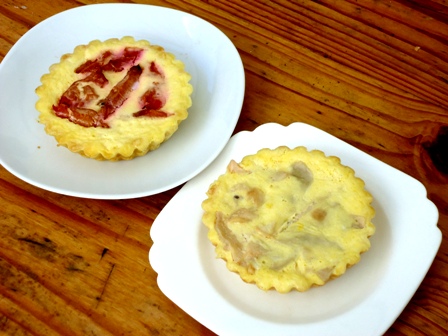
Fruit tarts

I made three of these tarts, in 10cm tins. Obviously, the ingredients may be expanded proportionately to make any number of individual tarts, or a larger one. However, this is what I did, with the quantities I had.

100g flour
50g butter
1dstsp caster sugar
Cold water
1 medium apple
2 Victoria plums
Caster sugar
1 egg, beaten
75ml creme fraiche
75ml milk
1tsp vanilla essence


Grate the butter into the flour, as rapidly as possible, so that it does not go squidgy in your hand. You should now be able to rub it in - or blend it in a food processor - in no time at all. Stir in the sugar. Add a little water, and bring the mixture together; keep adding water sparingly until you are able to form a dough. (I added too much to mine, with the result that the pastry was slightly stodgier - more glutenous - than it should have been.)

If you gently bring the dough together, it may fall apart when you try to roll it. If you knead it for a minute or two, it will be more coherent, but may be tougher as a result of the gluten that has developed. I didn't roll my pastry, because I tend to make a mess of the procedure, but got out the grater again and grated the dough into the tins. Then I spread it over the bases and up the sides with my fingers. (Experts recommend that before rolling you chill the dough, wrapped in cling film, for 30 minutes or longer.)

Put the pastry-lined tins on a baking sheet (which helps the bases to firm up) and bake for about 20 minutes, or until dry and golden. You might cover the dough with foil, weighed down with an ingredient such as rice or dried beans, for 15 of the 20 minutes, to stop it from buckling as the water content evaporates.

Peel the apple, quarter and core it, and slice it thinly. Quickly, before it discolours, transfer it to a heavy pan in which a small knob of butter is starting to sizzle over a gentle heat. Turn the slices to coat them in butter, and cook them gently until tender. Place the slices in one of the pastry-lined tins.

Halve the plums, stone them, and slice them. Put them into the two other pastry cases. Scatter a little sugar over the fruit.

Mix together the egg, creme fraiche, milk, and vanilla essence until smooth. (Use double cream if you can find only factory-made creme fraiche, which always splits, in my experience.) Spoon the custard mixture over the fruit in the tins. I didn't need all of it.

Bake the tarts, again on the baking sheet, at gas mark 3/160C for 20-30 minutes, or until the custard is set.

Saturday, August 06, 2011

Salt cod, potatoes and onions

Salt cod (morue) is widely available in supermarkets here in Normandy. I should guess that it is even more prevalent in the south. The kind I bought carried the claim that you could desalinate it in four hours; it remained salty after that time, but pleasantly so.

This is a Keith Floyd recipe. I ignored his recommendation that one cook the fish in a court bouillon, which seemed unlikely to be very influential during such a short procedure. Also, Floyd tells you to fry the potatoes in a covered pan. There are eight medium-sized potatoes in his recipe - how large a pan does he have in mind? A much larger one than I can lay my hands on at present, in any event. I roasted them instead.

Serves two.

400g salt cod, soaked according to the packet instructions
Butter and olive oil
4 medium potatoes, sliced
2 onions, sliced
Pepper


Drain the salt cod, cover it again in cold water in a saucepan, and bring to a simmer over a medium heat. As soon as the water starts to bubble, turn the heat right down, to avoid overcooking the fish and toughening it. It may be tender in just a few minutes. (Floyd gives a timing of 15 minutes, which is surely too long for even the thickest cut of fish.) Remove the cod to a plate, allow it to cool, and flake it.

Put a generous layer of olive oil into a roasting tin - one with a non-stick surface you can trust. Put the tin into a gas mark 6/200C oven for five minutes. Take it out, and tip in the potatoes, turning them to cover in hot oil. Roast them for 30 minutes, or until tender. Remove them to a plate, and mash them roughly with a fork.

In a heavy frying pan (one with a lid) or casserole dish (I used a Le Creuset), gently fry the onions in just enough oil and butter to prevent their sticking. Give them about 15 minutes, until they're golden.

Tip in the potatoes, and spread them out so that you're frying a potato and onion cake. Spread out the flaked cod on top, season with plenty of pepper, cover, and cook for 10 minutes, or until the base of the mix is crispy.

Wednesday, August 03, 2011

Courgette and aubergine stew

This would have been a ratatouille - albeit a cheat's one - with the addition of peppers, which I had forgotten to buy. Normally, I roast and skin them, and add them at the end. But I'm feeling a bit lazy during these early days of my holiday, so probably I would have cut them up and added them with the onions, before the courgettes.

The key is not to stew the dish for too long, allowing the ingredients to turn mushy. So you reduce the tomatoes before adding them. Authenticists might sauté each ingredient separately, before merging them for a brief simmer.

Serves two as a main course, or four as a side dish.

1 medium to large aubergine, cubed
2 plump tomatoes, or 1 tin tomatoes
3 cloves garlic, chopped
2 onions, roughly chopped
2 courgettes, sliced
Olive oil
Salt and pepper

Aubergine is difficult to tenderise by frying, I think. Instead, put the cubes into an oven dish, toss them with just enough oil to coat them, as well as with salt and pepper, and bake at gas mark 6/200C, turning once. French ones, which have meltingly soft flesh, are ready in about 20 minutes. The aubergines I buy in England take longer.

Put the fresh tomatoes, if using, into boiling water for about 20 seconds. Allow them to cool, and peel off their skins. Remove their cores, and chop them roughly. Simmer them in a small saucepan over a gentle heat until thick and mushy. (Another method is to chop up the unpeeled tomatoes, cook them, and push them through a sieve or through a food mill.) Or: pour the tinned tomatoes into a saucepan, and simmer until thick.

Warm a couple of tbsps of olive oil in a heavy pan over a gentle heat, and throw in the garlic and onions. Fry, adding more oil if the vegetables are in danger of sticking, until the onions soften - about 10 minutes. Turn up the heat to medium, throw in the courgettes with a little salt, and continue to cook, stirring almost continuously. The courgettes are soft when their rings of seeds show vividly.

Tip in the aubergines and tomato sauce, and continue to cook very gently for 10 minutes, stirring regularly. Check the seasoning.

I prefer to cover the pan, leave it, and eat the stew at room temperature.

Sunday, July 24, 2011

Greengage and blackberry fool


A very simple pudding. You use roughly the same quantity of cream as of fruit compote. The amount of sugar you need will vary according to the kind of fruit (or, in the case of rhubarb, vegetable). This fool includes about 20 greengages, two small punnets of blackberries, 2tbsps of caster sugar, 400ml of double cream, and 1tsp of vanilla essence.

Put about 50ml of water into a heavy saucepan, and throw in the greengages and blackberries with the sugar. Cover, bring to a simmer, and cook gently, stirring from time to time, until the fruit is very soft - no more than 15 minutes, probably. Force the compote through a sieve into another saucepan, pushing and stirring the fruit with a spoon.

Bring the sieved compote to a simmer again, and cook until it is lava-like in consistency, with big bubbles breaking the surface. Test for sweetness. Pour the compote into a bowl, and allow to cool. (It will thin the cream if it is hot.)

Whip the cream, with the vanilla if using, and stop as soon as it stiffens. (If you keep beating, it will become almost solid, and grainy too.)

Blend the cream and the compote, and chill for a couple of hours.

Sunday, July 17, 2011

Lamb leg steaks

These are steaks, which you would fry or grill, but from the leg, which you would roast. So how to cook them? I chose a compromise.

The marinade includes a garlic clove, crushed with salt; the juice of half a lemon; and about three tbsps of olive oil. The steaks sat in it for only half an hour.

I got a ridged grill pan very hot, scraped excess marinade off the steaks, and seared them (one at a time) for only a minute each side, just long enough to give them a griddled appearance. I returned them to the marinade in the oven dish, and roasted them for 30 minutes at gas mark 6/200C. Those who prefer their lamb to be less well done could allow at least 10 minutes fewer.

As you can see, they produced a fair amount of sauce.